Vale Raymond Leggett
The Queensland Naturalists’ Club (QNC) respectfully informs members of the passing of Ray Leggett on 14 May 2026, aged 89 years. Several QNC members attended Ray’s Farewell Service. As a boy Ray was given a copy of “What Bird is That?” by Neville Caley and so began a lifelong love of birds. However, Ray was especially known for his extensive knowledge of freshwater fish. Ray pioneered the exploration, identification and categorization of Australian native fish. Ray collected nearly 8000 freshwater fish specimens from Queensland of 99 species and achieved the captive breeding of 189 species of freshwater fish from Australia and internationally. His major study areas included southeast Queensland, the west coast of Cape York, the Burdekin River, Lake Broadwater, Musselbrook, White Mountains, Iron and McIlwraith Ranges as well as the Kimberley in Western Australia. Much of this fieldwork was undertaken at his own expense. In 1987 he co-authored “Australian Native Fishes for Aquariums”, a 241-page monograph on Australian freshwater fish husbandry with John Merrick. Ray was actively involved in the establishment of the Australian and New Guinea Fish Association. The New Guinea Rainbow Fish Glossolepis leggetti was named in his honour.
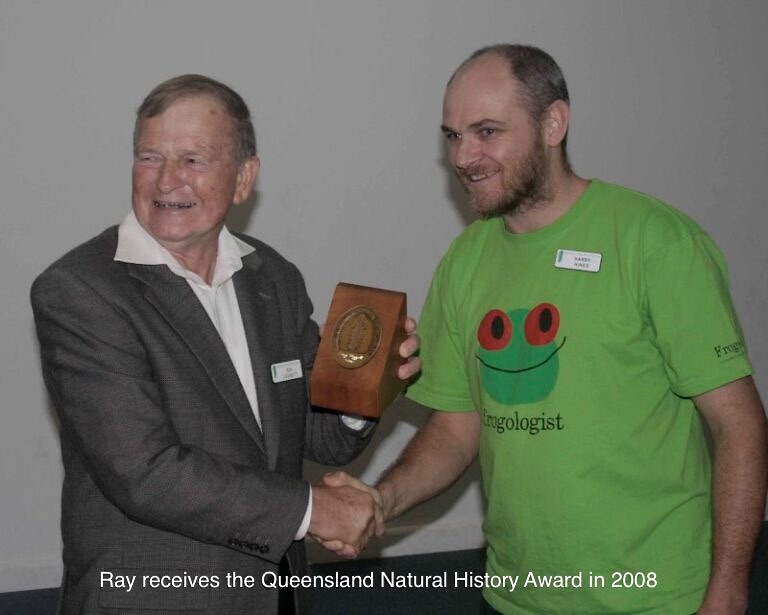
Ray was an Honorary Technical Assistant at the Queensland Museum where he performed curatorial, material conservation and exhibition preparation roles. He spent ten years at the Queensland Museum as an Interpretive Officer staffing the reference desk answering numerous public enquiries. He had a great ability to communicate with people of all ages. The Surat Public Aquarium, designed by Ray, is another example of his contribution to increasing the public’s awareness of natural ecosystems. Ray was awarded Lifetime Membership of The Queensland Naturalists’ Club where he served as President in 1981, 1982 and 2001 and 14 years on Council. In 2008 Ray was awarded the Queensland Natural History Award (header photo), which recognises persons who have made outstanding contributions to understanding Queensland’s natural history. Ray enthusiastically passed on his knowledge and experience of natural history to others, undoubtedly opening the eyes and ears of many to the wonders of Queensland’s natural history. The Council of The Queensland Naturalists’ Club extends our condolences to Ray’s family and friends.