
Excursion Report: Broadwater Campground, Sundown National Park, 17-22 April 2025
Excursion Report: Sundown National Park. Leader and report: Trevor Jack, et al.
The excursion was carried out from Thursday, 17 April to Tuesday 22 April 2025. Accommodation was at three campsites in the National Park Campground as well as the Ranger’s House. Twenty-four members (including a few new members) attended. The remote character of Sundown National Park and Sundown Resources Reserve (15,275 ha in total) is maintained by keeping development to a minimum. A gradual change in vegetation from north to south reflects the differing climate, elevation and soil types. We kept to the south where there are woodlands of Caley’s and silver-leaved ironbark, tumbledown red gum, white box and cypress pine, both white and black. Wilga, native willow and ooline (a vulnerable species) also grow in the south. (parks.desi.qld.gov.au).
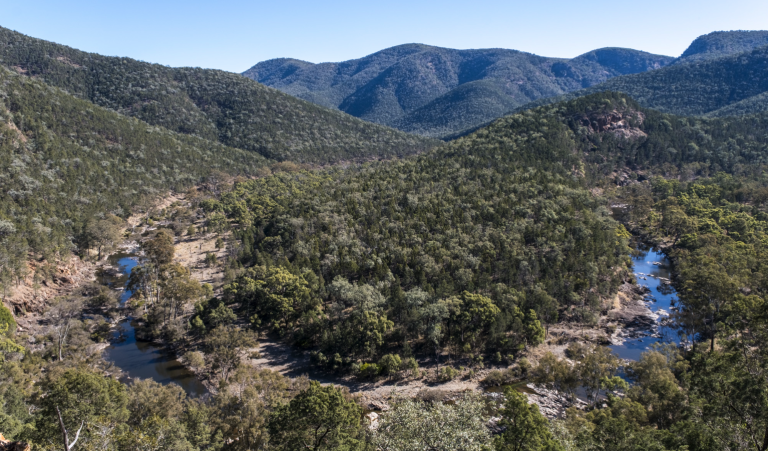
The campground is situated on the northern bank of the Severn River a short distance downstream from Permanent Waterhole close to where the Severn River is joined from the north by Ooline Creek and from the south by McAllisters Creek. Good rain earlier in the year had provided a plentiful supply of grass on the areas that were once used for grazing. Hence, there were many kangaroos (Eastern Grey; Macropus giganteus), and wallabies (Swamp wallaby; Wallabia bicolor) to be seen. Also, the rain had converted the Severn River from a series of water holes joined by dry creek beds into a free-flowing river.
Thursday saw the arrival of most participants with some spotlighting at night. Of note, three koalas (Phascolarctos cinereus) were seen in the early evening. A walk up Ooline Creek was conducted on Friday. The creek was a series of very shallow rocky waterholes. On Saturday, the Western Circuit was walked. This is a track of just over 4 km. The track goes up from the river, along a ridge, and then descends back to the campsite. This was significantly different from the riparian environment observed on the other days.
On Saturday night, we were joined by Lionel Eustace, a bush poet, who provided us with an hour of entertainment reciting several ‘true blue’ Aussie ballads. On Sunday, Lionel came with us as a guest member on the walk across the Severn River and on up to Permanent Waterhole. Of note was the observation of a Yellow-faced Whip Snake (Demansia psammophis) which had a spike of a Tiger Pear (Opuntia aurantiaca) embedded close to its neck. Lionel performed ‘snake whispering’ magic by catching the reptile, calming it, and gently removing the spike.
Monday saw a small group of five once again cross the river and walk up McAllisters Creek. Unfortunately, it rained making the rocks slippery and the group turned back at a slipway where it was deemed too dangerous to continue. Others revisited the Western Circuit for more extensive bird observations. Extremely comfortable conditions were enjoyed for the first four days with fine moderate days, and cool nights. Rain on Monday and through the night into Tuesday saw a wet pack-up.
David Niland, who is past president of Birds Queensland, addressed us on Sunday afternoon and shared fascinating ideas about an on-going long-term project of bird observation that Birds Queensland has in operation in this section of Sundown National Park. David requested that QNC members assist Birds Queensland with the identification of individual trees and other plants that birds use at way points on his bird survey maps
Sundown Nature Notes – By Greg Neill
Three members contributed to the eBird report for the camp 17 to 22 April, 2025. Some 78 species were recorded on 24 checklists over the six days of the camp. Two lists were from visits to Glenlyon Dam. Three of us spent one morning birding with David Niland of Birds Qld. David is running a citizen science project through Birds Qld to look at specific habitats for various bird species. To do this, David takes spot locations of birds and via GIS, analyses the habitat, height above sea level and season. On the morning several QNC members went out with David, 5 observers recorded 40 species in 2.5 hours over a distance of 2.3km. The number of species for this list is about 40% higher than any other eBird list previously recorded. The highlight of the list was two Eastern Shrike-tits (Falcunculus frontatus) actively feeding and calling. The other point of interest over the week-end camp was the number of Scarlet Honeyeaters (Myzomela sanguinolenta) observed. This species was constantly being heard in all areas and in good numbers.
Sundown Nature Notes by Ruth Palsson
This short report will focus on plants and biocontrol of Opuntia cacti because those are my interests. For the Easter Outing, QNC observers uploaded to iNat 205 observations of plants across 101 species including ~21 weeds, including three Opuntioid cacti and two biocontrol agents. Uploading weed sightings is vitally important so that scientists know where weeds are moving. Herbaria no longer send out botanists on collection trips just to collect whatever they can find in a particular area. It was good to see many weeds recorded. I know I missed many weeds, but there was only a limited amount of time! Some of our observations were firsts in iNaturalist for that species at Sundown NP. These included (* indicates an introduced species):
- Swainsona oroboides – Variable Swainsona, by Delma Clifton and others with the same plant found on the Western Circuit Walk;
• Oxytes brachypoda – Large Ticktrefoil, by Margaret Donald and others on the Western Circuit Walk;
• Ophioglossum lusitanicum – Austral Adder’s-Tongue, by Ruth Palsson;
• Glossostigma – Mudmats in shallow water in Ooline Ck, by Ruth Palsson;
• The grass, Chrysopogon filipes, by Martin Hannan-Jones;
• *Calyptocarpus vialis – Straggler Daisy, by Doug Freckelton;
• *Dactylopius austrinus – a cochineal insect that uses Tiger pear as a host, by Ruth Palsson. This was only the second record on iNat for Dactylopius austrinus;
• *Cactoblastis cactorum – Cactoblastis Moth, by Ruth Palsson;
• *Passiflora subpeltata – White Passionflower, by Ruth Palsson;
• * Petunia axillaris – Large White Petunia, by Ruth Palsson;
• * Schkuhria pinnata – Dwarf Marigold, by Ruth Palsson;
• * Guilleminea densa – Small Matweed, by Ruth Palsson; and
• Isidorella hainesii – a freshwater snail, found in shallow water in Ooline Ck by Delma Clifton;
• Eucalyptus moluccana – Grey Box or Gum-topped Box – a small forest on flats near Rangers house by Greg Neill;
• Galls – in the fruit of Notelaea microcarpa, found by Greg Neill.
Amazing how much is still to be recorded for the first time in a popular national park!
I made 15 observations of Opuntia tomentosa (Woollyjoint Pricklypear/Tree Pear), five observations of Opuntia aurantiaca (Tiger Pear) and two observations of Opuntia anahuacensis (Beach Prickly Pear/common Prickly Pear). One of my “things” on iNat is to record cactus locations, mainly Opuntia tomentosa, and their associated biocontrol agents. Currently, I have 112 observations of Opuntia tomentosa, mainly in NSW, but some in southern Qld. I do not record every Opuntioid cactus that I see; I record enough to give an indication of how widespread they are.
At Sundown NP, biocontrol agents were sparse. I only found evidence of Cactoblastis cactorum (Cactoblastis Moth) on one Tree Pear and found no evidence of Dactylopius opuntiae (Cactus Scattered Cochineal) on the Tree Pear or Common Prickly Pear. We saw heaps of Tiger Pear, but only found Dactylopius austrinus, the cochineal insect that attacks Tiger Pear in a short section of McAllisters Creek. I felt we had a successful trip to Sundown NP; I had a great time with great company!
Images and Further Information regarding the Flora and Fauna from this excursion can be found on the iNaturalist Sundown project: QNC Sundown NP Project